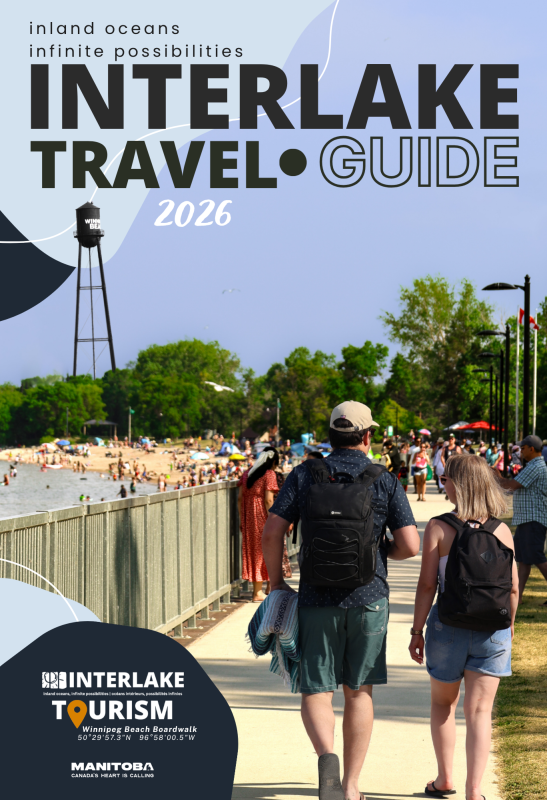
Fourteen places that shaped the heart of Manitoba
A history series for Interlake Tourism, sourced from the Manitoba Historical Society archives.
The Interlake is easy to drive through. Highway 9 north out of Winnipeg, flat land on both sides, the lake appearing and disappearing behind tree lines, small towns spaced out every 30 or 40 kilometres. Easy to pass without stopping. Easy to assume there is not much to see.
That assumption is wrong.
The region between Lake Winnipeg and Lake Manitoba is one of the most historically layered places in Canada. It was named before it was a province. It was settled by people who came with nothing and built their own constitutions. It sent limestone to build Winnipeg. It printed the first Icelandic-language newspaper in North America. It ran a trolley to the city. It put 40,000 people on a beach in a single day.
None of this is widely known outside the region. That is what this series is about.
What follows is an account of fourteen places across the Interlake, each one sourced from the Manitoba Historical Society archives at mhs.mb.ca. Taken together, they tell a story about what was built here, who built it, and why it still matters.
Part One: The Name of a Province
Before the Interlake had a name, before the province had a name, there was a sound.
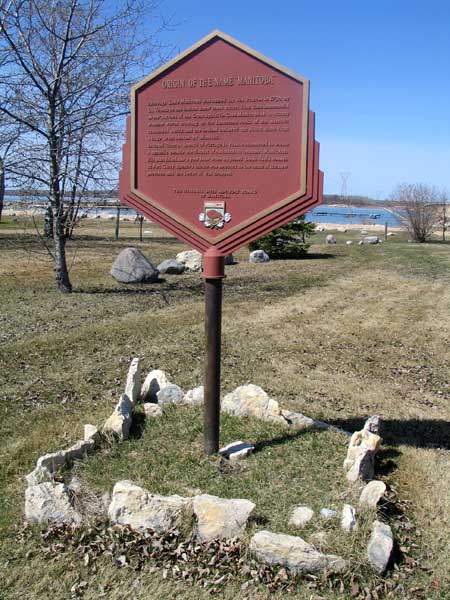
At Lake Manitoba Narrows, where the lake pinches to a narrow channel in the Municipality of West Interlake, the Cree called the place “Manito bau,” meaning the narrows of the Great Spirit. When storms came in across the water, waves struck the limestone shoreline in a way that produced a low, resonant, drum-like sound. They believed it was the voice of Manitou.
In 1868, a man named Thomas Spence arrived and tried to found a republic here. He called it Manitobah. The republic failed, but the name persisted. When Louis Riel’s council named the new province in 1870, they dropped the H and kept everything else.
A commemorative monument has stood at Lake Manitoba Narrows since 1957. It is not a famous landmark. Most people who drive past it have no idea what it marks. But the name of the entire province is rooted in the sound of waves on a limestone shore in the West Interlake.
Part Two: A New World on the Lakeshore
The story of New Iceland is one of the most remarkable settlement stories in Canadian history, and most Canadians have never heard it.
In October 1875, approximately 235 Icelandic settlers landed on the western shore of Lake Winnipeg at a place they called Willow Point. They named their settlement Gimli, after the home of the Norse gods. The following summer, more than 1,200 additional settlers arrived directly from Iceland, driven out by a series of volcanic eruptions that had destroyed 2,500 square miles of farmland.
What they built in the years that followed was extraordinary. By 1878, New Iceland had its own written constitution, dividing the territory into four districts, each with an elected council modelled on Iceland’s ancient parliament, the Althing. Self-governing on the Canadian frontier. Today, roughly 100,000 Manitobans trace their roots to this shoreline.
On the northwest corner of Hecla Island, which became part of the New Iceland territory, the community founded the Kirkjubol homestead. In the autumn of 1876, smallpox swept through. Over 100 people died. New Iceland was placed under quarantine. A cemetery was established at Kirkjubol for the victims, and then, over the following decades, its location was forgotten entirely. It disappeared beneath the grass. Generations later, the site was rediscovered: a clearing, a two-storey log structure still standing, and the quiet weight of a community that had survived the unsurvivable.
At the northern tip of Hecla Island, at Gull Harbour, two lighthouses were built to guide the fishermen and freight haulers who depended on Lake Winnipeg as a highway. The shorter wooden one dates from 1898. The taller steel tower was built in 1926. Both are still tended by the Canadian Coast Guard today.
And in Gimli itself, standing 15 feet tall on the shore, a fibreglass Viking has kept watch since 1967. He was designed by University of Manitoba professor Gissur Eliasson and sculpted by George Barone at a cost of $15,000, built as a Canadian Centennial project. When he was unveiled, the ceremony was attended by Asgeir Asgeirsson, the President of Iceland. In 2017, Viking Park was built around the statue for the Icelandic Festival’s 125th anniversary, with stelae bearing the names of Icelandic families who shaped this place.
Part Three: The Industry That Built Manitoba
While the Icelandic settlers were establishing their location to the north, a different kind of industry was taking shape further south.
At Stonewall, limestone quarrying began around 1880. The town’s very name comes from the stone. A man named Samuel Jackson had recognized that the land around the settlement sat atop limestone deposits of exceptional quality, and that a railway line was coming. He offered building stone free of charge to settlers willing to establish farms around the townsite. In return, he named the town.
By the time the colonization rail line arrived from Winnipeg in 1881, quarry operations were already underway. The stone and high-quality quicklime produced at Stonewall were shipped south to supply the construction boom, transforming Winnipeg from a frontier post into a city. Five kilns burned continuously at the quarry’s peak. Operations ran until 1967.
Those kilns still stand today in Quarry Park at the north end of Stonewall. A three-phase restoration project launched in 2019 is working to save them. The first draw kiln was carefully disassembled stone by stone, each one labelled, and is being rebuilt. The great white bluffs of slag still visible in the park are the accumulated waste of nearly nine decades of continuous operation.
Further west, in the Municipality of West Interlake, the Rosehill Limestone Quarry tells a smaller version of the same story. Established in 1896 by James and Bob Young, with Charles Maloan joining as a partner in 1898, the operation incorporated in 1902 as the Manitoba Union Mining Company. The quarry is long silent, but its kilns are still standing, weathered and patient in a field that most people drive past without stopping.
Part Four: The People Who Stayed
Settlement in the Interlake was not exclusively Icelandic. The region drew immigrants from across Europe, and their stories are preserved in the buildings and institutions they left behind.
The Arborg and District Multicultural Heritage Village, situated on 12.9 acres along the Icelandic River, preserves the material history of the region’s diverse settler communities. Among its most remarkable artifacts is the Hykaway Grist Mill, built around 1910 by a settler named John Hykaway near Meleb. He had no manufactured parts. The millstones were chiselled by hand from boulders found on his own farm. The sails were made from thin spruce branches. The gears were hand-carved from logs. It took two years to build. When it finally ran, people came from miles around to grind their grain. It operated until 1943.
Also at the heritage village is the Vigfusson House, built around 1898 in the village of Lundi, present-day Riverton. When Trausti Vigfusson moved the house in 1902, he disassembled it log by log and carved Roman numerals into each one to aid reassembly. He moved it by horse-drawn wagon to the Geysir area. The house is considered one of the oldest surviving log structures in New Iceland.
At Arborg itself, the Ukrainian Catholic community built St. Demetrius Church in 1921 in the nearby Bjarmi area. The building was later moved to the heritage village and restored. The cemetery it once stood beside remains in place in the Municipality of Bifrost-Riverton, a quiet testament to a community that arrived, built a church, and made the Interlake their home.
Part Five: Words and Wire
In September 1877, in a log building at a small Icelandic settlement on the bank of the Icelandic River, a printing press began to run.
The paper it produced was called Framfari, meaning Progress. It was the first Icelandic-language newspaper ever printed in North America. The editors were Sigtryggur Jonasson and Halldor Briem. The settlement was then called Lundi, an Icelandic word meaning grove of trees. The paper ran until January 1880.
Jonasson went on to become the first Icelandic member of the Manitoba Legislature. When the railway arrived, Lundi was renamed Riverton. A monument in Riverton’s Centennial Park now honours the founders of Framfari. That a community still constructing its first homes found the means to start a newspaper says something essential about the people who settled this region.
The same drive that produced Framfari also produced infrastructure. In 1882, the Rockwood Registry Office was built in Stonewall as the first municipal building in the Rural Municipality of Rockwood. Thirty years later, from 1914 to 1939, it found a second life as a passenger station for a trolley line operated by the Winnipeg, Selkirk and Lake Winnipeg Railway Company, carrying commuters between Stonewall and the city. One building. Two complete eras of community life.
Part Six: A Summer the City Built
In 1900, the Canadian Pacific Railway purchased 32 acres of undeveloped shoreline on the southwestern shore of Lake Winnipeg, 65 kilometres north of Winnipeg, and built a resort from nothing.
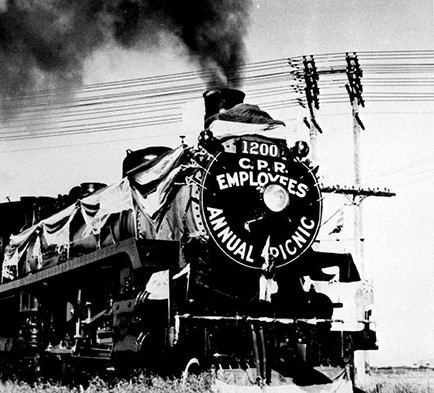
Winnipeg Beach became one of western Canada’s premier summer destinations. Within a decade, between 12 and 15 trains were running on busy holiday weekends, carrying more than 40,000 passengers a day. There was a dance pavilion, a boardwalk, a rollercoaster, rental cabins, and a three-kilometre stretch of sandy beach. By 1920, 15,000 people made the trip on 13 trains for the July 1 weekend alone. The Moonlight Special ran every evening.
The amusement park closed in 1964. Of all the structures the CPR built at Winnipeg Beach, only the steel water tower from 1928 survives. It was designed and built by the Vulcan Iron Works Limited of Winnipeg. It still stands on Kernstead Road, the last physical witness to everything that once surrounded it.
North of Gimli, at Camp Morton on the west shore of Lake Winnipeg, a different kind of summer refuge was being built at the same time. Camp Morton was founded in 1920 by Monsignor Thomas W. Morton, who had come from England to serve as rector of St. Mary’s Cathedral in Winnipeg. He built the camp as a summer outdoor refuge for orphaned and underprivileged children. In 1943, a row of log cottages known as The Arcade was constructed for visitors and staff, built from logs cut to two-foot lengths and embedded in mortar, a technique with excellent insulation value still used in the Interlake today. A stone grotto on the lakeshore was one of several places of worship throughout the camp. Today Camp Morton is a provincial park. The buildings still stand.
Part Seven: The End of the Line
Every railway line has a final stop. On the CPR Winnipeg Beach Subdivision, the northernmost point of the line was Riverton.
The town itself had changed names twice before the railway arrived. It was Sandy Bar first, then Lundi, then Riverton when the tracks came through. The former CPR station now houses the Riverton Transportation and Heritage Centre, established in September 2000. Outside stands a large moose statue named Lundi, sculpted by Grant McLaughlin of Moose Jaw and erected in 2007, a nod to the settlement’s original name.
The railway that once brought settlers north and carried fish and lumber south is long gone. The station where the line ended still stands.
The Interlake is not a place that announces itself.
Its history does not stand on main streets with interpretive panels. It is in the kilns at the edge of a field. It is in the sound of waves on limestone. It is in the Roman numerals carved into logs before they were moved by horse-drawn wagon. It is in a printing press running in a building that no longer exists, in a town that no longer bears its original name.
These fourteen places are not a complete account of the Interlake. They are a beginning. The Manitoba Historical Society archives at mhs.mb.ca hold thousands of records documenting this region, and the work of connecting those records to the places that can still be visited is ongoing.
The Interlake does not need to be explained. It needs to be found.
Sources and Footnotes
All sources are drawn from the Manitoba Historical Society archives at mhs.mb.ca. Direct links are provided for each entry.
LAKE MANITOBA NARROWS
[1] “Manito bau,” Cree name meaning the narrows of the Great Spirit; Thomas Spence’s 1868 republic attempt; commemorative monument erected 1957 by the Historic Sites Advisory Board of Manitoba. Historic Sites of Manitoba: Lake Manitoba Narrows
[2] “How Manitoba Got Its Name” by Frank Hall, Manitoba Pageant, Vol. 15, No. 2, Winter 1970. mhs.mb.ca/docs/pageant/15/manitobaname1.shtml
NEW ICELAND, GIMLI
[3] First settlers arrived October 21, 1875 at Willow Point; over 1,200 more arrived in 1876. Manitoba History: New Iceland, MHS
[4] Constitution of New Iceland ratified 1878; four districts modelled on Iceland’s Althing. Manitoba History: Nyja Island I Kanada, MHS
[5] Walking tour of Gimli historic sites. mhs.mb.ca/docs/features/walkingtours/gimli/index.shtml
KIRKJUBOL CEMETERY, HECLA ISLAND
[6] 1876 smallpox epidemic; 102 deaths; quarantine imposed November 27. MHS Transactions: John Taylor and the Pioneer Icelandic Settlement
[7] Kirkjubol Cemetery: location lost and later rediscovered in waist-high grass; two-storey log structure still standing. Historic Sites of Manitoba: Kirkjubol Cemetery, MHS
GULL HARBOUR LIGHTHOUSES, HECLA ISLAND
[8] Wooden lighthouse dates from 1898; steel lighthouse built 1926; both tended by Canadian Coast Guard. Historic Sites of Manitoba: Gull Harbour Lighthouses, MHS
[9] Hecla Island sawmill established 1913 by Sigurgeirsson family; lumber shipped to Selkirk and Winnipeg. Historic Sites of Manitoba: Hecla Saw Mill, MHS
GIANT VIKING STATUE, GIMLI
[10] Viking statue: 4.6m fibreglass, designed by Gissur Eliasson (University of Manitoba), sculpted by George Barone, cost $15,000. Unveiled 1967 by Iceland President Asgeir Asgeirsson. Viking Park opened 5 August 2017. Historic Sites of Manitoba: Giant Viking Statue, MHS
[11] “Manitoba’s Viking Aesthetic” by Andrew McGillivray, Prairie History No. 6, Fall 2021. mhs.mb.ca/docs/prairiehistory/06/vikingaesthetic.shtml
ROSEHILL LIMESTONE QUARRY, WEST INTERLAKE
[12] Quarry established 1896 by James and Bob Young; Charles Maloan added 1898; Manitoba Union Mining Company incorporated 1902. Historic Sites of Manitoba: Rosehill Limestone Quarry and Kilns, MHS
ERIKSDALE
[13] Jonas Erikson arrived 1906 as second settler; named town as railway crossed his land; donated land for hospital in 1917. Historic Sites of Manitoba: Erikson Monument, MHS
[14] Eriksdale Creamery constructed c. 1912 by Brandon Creamery and Supply Company; expanded multiple times. Historic Sites of Manitoba: Eriksdale Museum, MHS
WINNIPEG BEACH
[15] CPR purchased 32 acres in 1900; up to 40,000 passengers on holiday weekends; amusement park closed 1964. Steel water tower built 1928 by Vulcan Iron Works Limited of Winnipeg. Historic Sites of Manitoba: CPR Water Tower, Winnipeg Beach, MHS
[16] 15,000 people on 13 trains for July 1, 1920; nightly Moonlight Special; dance pavilion and rollercoaster. Manitoba History: Winnipeg Beach by Moonlight, MHS
STONEWALL QUARRY
[17] Limestone quarrying began around 1880; five kilns producing quicklime; operations ceased 1967. Save the Kilns restoration project began 2019. Historic Sites of Manitoba: Stonewall Limestone Quarries and Kilns, MHS
[18] Historical context of the quarry and its role in Winnipeg’s construction. Manitoba History: Stonewall and its Quarry Park, MHS
RIVERTON CENTENNIAL PARK / FRAMFARI
[19] Framfari (“Progress”), first Icelandic-language newspaper in North America, published at Riverton (then Lundi) from 10 September 1877 to 24 January 1880. Editors Sigtryggur Jonasson and Halldor Briem. Town renamed from Lundi to Riverton on arrival of the railway. Historic Sites of Manitoba: Riverton Centennial Park, MHS
CAMP MORTON, RM OF GIMLI
[20] Camp Morton founded 1920 by Monsignor Thomas W. Morton; log cottages (“The Arcade”) built 1943 from two-foot log lengths embedded in mortar. Morton arrived from England in 1919 to serve as rector of St. Mary’s Cathedral, Winnipeg. Historic Sites of Manitoba: Camp Morton, MHS
ARBORG AND DISTRICT MULTICULTURAL HERITAGE VILLAGE
[21] Hykaway Grist Mill built around 1910; millstones from farm boulders; sails from spruce branches; hand-carved log gears; took two years; operated until 1943. Vigfusson House built around 1898 in Lundi; logs numbered with Roman numerals for reassembly; moved by horse-drawn wagon. Historic Sites of Manitoba: Arborg and District Multicultural Heritage Village, MHS
ROCKWOOD REGISTRY OFFICE, STONEWALL
[22] Rockwood Registry Office constructed 1882; first municipal building in the RM of Rockwood. Served as passenger station for Winnipeg, Selkirk and Lake Winnipeg Railway trolley line from 1914 to 1939. Historic Sites of Manitoba: Rockwood Registry Office, MHS
RIVERTON TRANSPORTATION AND HERITAGE CENTRE
[23] Riverton station: final stop on CPR Winnipeg Beach Subdivision; heritage centre established September 2000. Moose statue “Lundi” sculpted by Grant McLaughlin of Moose Jaw, erected June 2007. Town known as Sandy Bar, then Lundi, renamed Riverton with arrival of the railway. Historic Sites of Manitoba: Riverton Transportation and Heritage Centre, MHS
ABOUT THE ARCHIVES
All historical information in this series is drawn from the Manitoba Historical Society’s Historic Sites of Manitoba database, an ongoing project documenting over 9,000 sites across the province. The database includes photographs, historical notes, commemorative plaques, and bibliography entries for each site.
Main archive: mhs.mb.ca/docs/sites/
Interlake Tourism is grateful to the Manitoba Historical Society for the preservation of these records and their ongoing contribution to the cultural heritage of Manitoba.